Snowflake sets the table for workplace hospitality.
A carry-in catering service was no longer going to cut it. When Snowflake, a global player in cloud-based AI and data services, determined it needed a bigger footprint for its office space in the Pacific Northwest, its global food and beverage team realized the new Bellevue, Wash., location would need a robust in-house meal program to match — and grow over time.
The push-pull tension of return-to-work office policies and fierce competition for top-tier talent — especially among tech companies — compels much of corporate America to rethink the amenities that will prove most tempting. Dining that leans more to “hospitality” than to “foodservice” is an undeniable draw. Evidenced by its newly opened in-house eatery, The Lodge, Snowflake’s leadership got the memo.
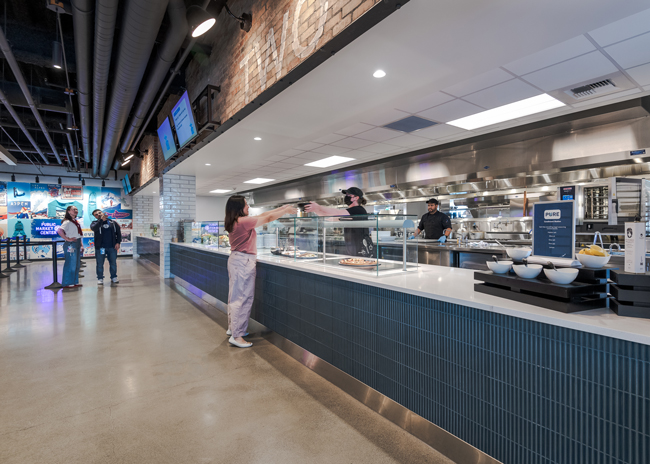 The servery design focused on accommodating a high number of diners in a short time span. Photos courtesy of Bolig Photography, photos by Pamela Bolig.
In May of 2025 Snowflake opened a 6,000-square-foot kitchen with full scratch-cook and cook-chill capabilities and a 5,200-square-foot multistation servery, currently accommodating nearly 1,000 employee diners.
To bring the vision to life, Snowflake’s food and beverage and design departments partnered with JPC Architects and NGAssociates Foodservice Consultants, a foodservice design consultancy managing global projects. NGAssociates assisted with both foodservice programming elements and full-service kitchen and servery design. Daily on-site management and execution of the operation is handled by Sifted, headquartered in Atlanta.
One notable example of its hospitality-first approach is the lack of self-service stations with this project. “The plate is handed to the guest. ‘I made this for you,’” says Paul Bohbot, Snowflake’s global food and beverage manager. This simple act reflects what might be described as the heartbeat of hospitality. “Food products take a lot of energy and effort to grow, to ship, to be prepped into a meal. Cooks respect the product all the way through the process, and that can’t be lost on that handoff to the guest,” he notes.
Bryan Sherburn, design project manager, NGAssociates, agrees. “This interaction between people is particularly important as we drive the return to the workplace,” he says. “You can make a salad in your kitchen, or you can come here and talk to someone who is making you a salad — and one that is good.”
Strategic Imperatives
The initial phase of the build-out focused on five floors of an eventual 11-story structure that Snowflake will complete over the next three years. The company expects the facility will house up to 1,800 employees one day. “Our primary goal was to construct a back-of-house kitchen facility capable of supporting the office space when fully populated,” explains Bohbot.
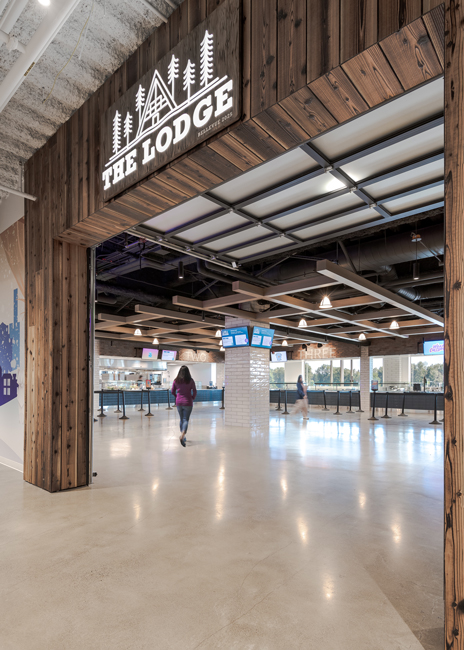 Employees entering The Lodge at Snowflake’s Bellevue, Wash., building are greeted by a large, open servery space.When the building opened, 600 Snowflake employees occupied the space; six months later that number had already increased to 900. The kitchen design team built in the ability to scale knowing occupancy numbers would continue to increase. “We needed to design the space with equipment that would give us the ability to scale, while still allowing the staff to be efficient in their workday,” says Bohbot. In the future, there is a possibility that the top floors of the building could include additional kitchen and dining space.
Initial thinking about foodservice and hospitality in this new space started with the menu. “People don’t really think about quality foods coming from workplace dining. They’re usually thinking, ‘cafeteria’ and ‘sandwich of the day,’” says Sherburn. “We started by meeting with Paul and his team to understand what kind of food they wanted. They wanted to bring that Bay-area, tech-industry feel to this building in Bellevue, Wash., and make it feel like a place you’d want to work.”
A top priority was optimal product and people flow for the kitchen team, says Sherburn. Foodservice operates from the third floor, complicating both receiving and support of other points of service throughout the building. The foodservice design addresses those challenges by establishing distribution pathways that provide an intuitive flow of deliveries from the receiving area located near the freight elevator through storage to prep to finishing in the servery and back again for ease of replenishing product. Additionally, the design does not include any full-height walls or partitions to make it easier for the foodservice team to view and communicate throughout the entire back of house.
Equipment choices support efficiency, culinary craft and menu flexibility. The cookline provides one such example of this. “If you can dream it, it can be made,” says Sherburn. “They can make fresh breads, they can do stews and curries, short cook, long cook, smoking — if they want to do it, it can be done.”
For Bohbot, roll-in combi ovens and a pass-through blast chiller are standouts. “I really wanted this kitchen to function in such a way that we could minimize touches in production,” he recounts. NGAssociates ensured that items going into the blast chiller could roll directly from the oven into the unit, chill down quickly, then pass through a connected door right into the service walk-in for later finishing — “all with minimal extra steps,” says Bohbot.
Mobile prep tables feature built-in power outlets, and overhead cord reels ensure that “power is always within reach wherever you go,” says Sherburn. “There’s a lot of flexibility to move things around for prep and power needs to be flexible, as well.”
The pressure tilt skillet enables staff to batch-cook large volumes in a short amount of time. “This 40-gallon skillet serves as a giant pressure cooker,” says Sherburn. “You get the quality you get in a slow cooker in a fraction of the time.”
“The tilt skillet brings the most production value,” says Bohbot. “It cuts cooking times for high-volume items like broths, stocks, stews and beans by up to 80%.” He adds that the culinary team is still getting fully up to speed with this piece of equipment. “We have to dedicate time to get staff fully trained and competent to use it safely and efficiently,” he says.
A show-stopping element of the cookline is the wok range. “There’s just something about the sound of the burners and watching a great wok cook work that’s like seeing a magician perform,” Bohbot says. “It always brings energy to the kitchen.”
That said, adding a wok range requires plenty of thought and attention to detail. “There’s so much to wok cooking from a chef’s perspective. There’s water involved; you need space nearby for the chef’s tools and the ingredients,” Sherburn adds. “You need something like a cockpit to have access to everything you need within reach, because they are cooking at such high temperatures, they can’t just throw something on the burner and then walk to the back of house to get shallots. You have to create an entire space, and being able to execute that just feels really good.”
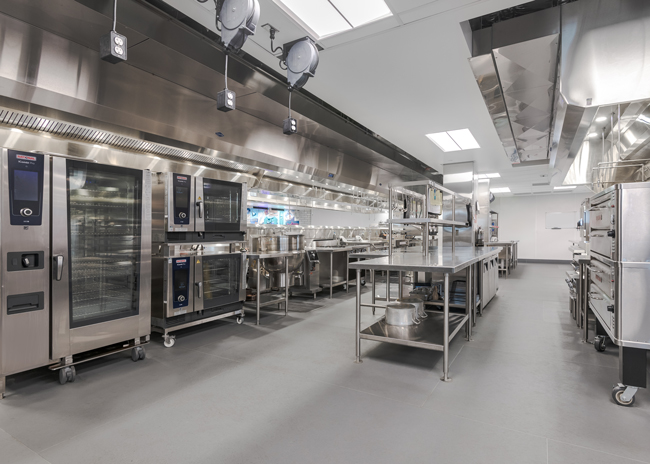 Overhead power cord reels and casters on equipment are two small but important elements that provide maximum flexibility. A wall cutout enables guests to see the culinary team in action.
Destination Dining
“The design of the main servery focused on creating an efficient service space for both guests and the culinary team that features multiple concepts offering approachable, scratch-made meals suitable for a variety of dietary preferences,” says Bohbot. It’s intentionally designed to reflect the Pacific Northwest location, drawing inspiration from Seattle’s Pike Place Market. Nearly three dozen Snowflake offices across the globe offer foodservice, and while programmatic standards are critical, workplace dining is not a cookie-cutter program, he explains. “We are very cognizant that each site should speak to the location.”
The design of the servery and the dining space also capitalizes on beautiful views that come with that third-floor vantage point. “We worked to maintain the sight lines to make sure the space we were providing paid respect to the setting,” says Sherburn. “The length of the salad bar is backed by these counter-height-to-ceiling windows that look out over the mountains. It’s quite a stunning view for a workplace cafeteria. We worked hard to make sure it didn’t have an old-school institutional cafeteria feel often associated with workplace dining.”
The food and beverage program at the Bellevue office features five menu concepts: pizza; made-to-order salads and wraps; a concept named Pure, which features items prepared with minimal oils and salts; and two global stations, one that specifically alternates Asian and Indian cuisine weekly and another that is broader, with offerings that might range from French bistro favorites to Mediterranean classics to iconic American fare.
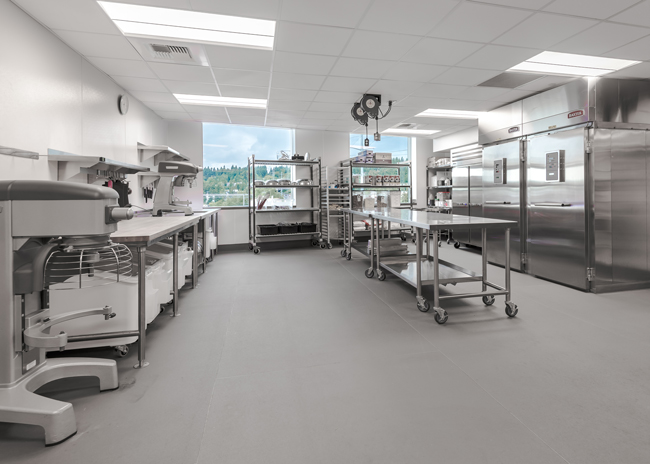 Windows in the kitchen bring in natural light for the culinary team.
Breakfast is also offered at an expanded continental breakfast bar with a featured daily hot entree. Topping off the menu mix is a can’t-be-beat price point: free.
In addition to breakfast and lunch, throughout the week Snowflake offers culinary pop-ups intended to surprise and delight. These can be as simple as cookies in the dining room or more elaborate, such as a sushi experience in a designated break room. “Culinary pop-ups are not restricted to the culinary space,” says Bohbot. “It’s a great way for the culinary staff to interact in a more engaged way with employees.”
Coffee as an amenity is offered throughout the building, and break rooms on all floors feature full-size refrigerated units and foodservice basics: packaged snacks, beverages, coffee, water, ice, etc. Snowflake also offers an elevated coffee experience, managed by Charlotte, N.C.-based Canteen, that includes house-made biscotti and high-end beverages on the newly opened sixth floor.
A Powerful Lure
Sherburn and Bohbot are fully convinced of the power of a high-quality foodservice program when it comes to attracting and retaining top talent in a competitive labor market. The new Bellevue building enjoys a 20% increase in office utilization without any increase in population, meaning staff are on-site more. Employees now have a nicer building, more on-site amenities, and an elevated, all-you-care-to-eat food program with zero cost to the employee, says Bohbot. He notes that such upgrades are driving people to the office at other Snowflake sites, as well.
“You look at the businesses that are following this trend around workplace dining and other amenities — they’re usually very successful in meeting their hiring standards,” says Sherburn. “They rarely have to worry about filling an office — or getting use of their foodservice spaces.”
Many Snowflake employees at the Bellevue office have a hybrid schedule option, set at departmental discretion. In general, peak in-office days fall toward the middle of the week, says Bohbot. On lower-attendance days, there is some menu flexing to ensure operational and cost efficiencies. For example, select stations are closed on Mondays and Fridays. The final decision on what to close is based on a variety of additional factors, from concept popularity to labor and prep requirements to quality considerations (same-day pizza dough falls short of the standard, and with no labor scheduled on Sundays, pizza goes dark on Mondays). “We’re a data company; we’re looking at data points all the time,” says Bohbot. He frequently looks at the analysis that forecasts headcounts and helps direct programmatic decisions like hours of operation.
At Snowflake, where data flows, hospitality follows. It’s this combination of thoughtful analysis with a people-first ethos that sets this corporate dining program apart.
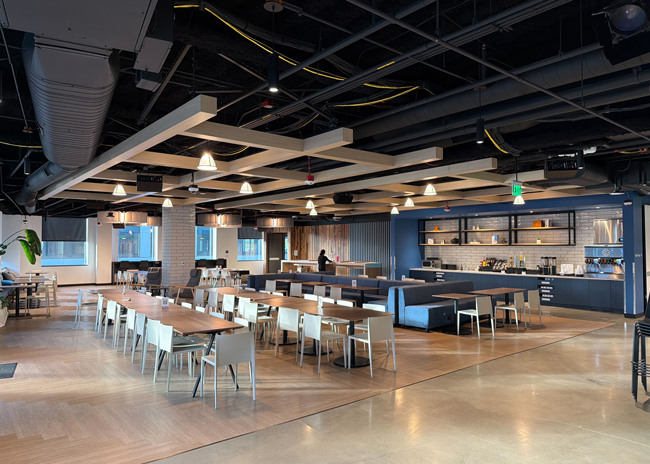 A large dining area can accommodate roughly 1,000 diners at one time.
Unusual Design: A Peekaboo Dish Room
Snowflake took the idea of inviting guests to watch a chef at work and applied it to an unlikely area of the back of the house — the dish room. The intentional, curated view of the area was to create more of a connection with the people working in that space.
“Snowflake wanted a dish return area that would efficiently accommodate the high volume of reusable dishware after peak meal periods, so there is a return conveyor. But conveyors don’t have faces to let diners know there’s someone back there taking care of your dishes. So, the area includes view panels that allow employee diners to see those team members at work,” recounts Sherburn.
“The chef told us, ‘I want guests to know that throughout this whole process, there are people involved making their food, taking care of their dishes. There is a human touch involved. Food is humanity,’” Sherburn says. “I have not seen this on a project before or since.”