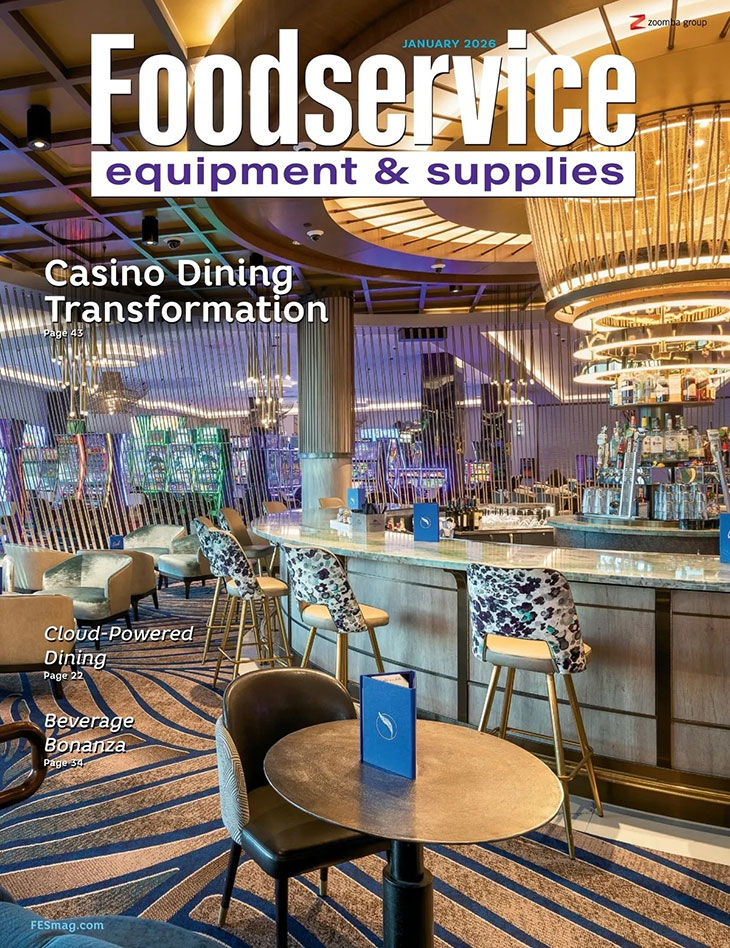
Five factors shaping the rethink around on-site food and beverage programs in the corporate dining segment.
Let’s get one thing straight: “B&I Foodservice” has become outdated terminology and does not reflect the contemporary, solutions-oriented approaches this segment demands today — especially in the post-COVID era. Indeed, younger stakeholders often don’t even know what the “B&I” acronym stands for (business and industry), says Jenna Calhoun, president, Society for Hospitality and Food Management (SHFM), and global account management lead-Americas at JLL, a real estate and investment management firm.
“The shift in verbiage is very real,” says Calhoun. She notes a greater usage of “workplace hospitality” trending, which speaks to a landscape evolution in businesses offering staff food plus other on-site amenities. Many see it as an elevated projection of foodservice, one that accords greater respect for the food and beverage program, as well as for the customer base: members of the U.S. workforce.
The reframing of the language signals a key consideration for stakeholders in this segment as they contemplate how to succeed in an ever-evolving environment. Today’s workplace diners have more options than ever. Not only must an on-site food program compete with the price and customization advantages of the lunchbox from home, but third-party delivery apps have also given area restaurants a greater reach into the workplace. Plus, ready-to-eat options from nearby supermarkets and convenience stores continue to hit new heights in quality. Gaining participation in workplace dining programs, then, means considering all these factors in order for on-site offerings to remain the option of choice.
Hospitality is both invisible and obvious. It’s personal but highly professional. It’s predictable yet surprising (in all the best ways). Innovative leaders in workplace hospitality find new ways to stand out and find opportunities amidst the challenges.
Here are five broad trends expected to impact the direction of the workplace dining sector.
1. The New Normal
Post-pandemic return-to-office (RTO) transitions began in 2023, and three years later, they continue to make news. Throughout 2025, The Wall Street Journal published a series of articles about the struggles around RTO, revealing that while the number of corporate mandates are up, office attendance is not.
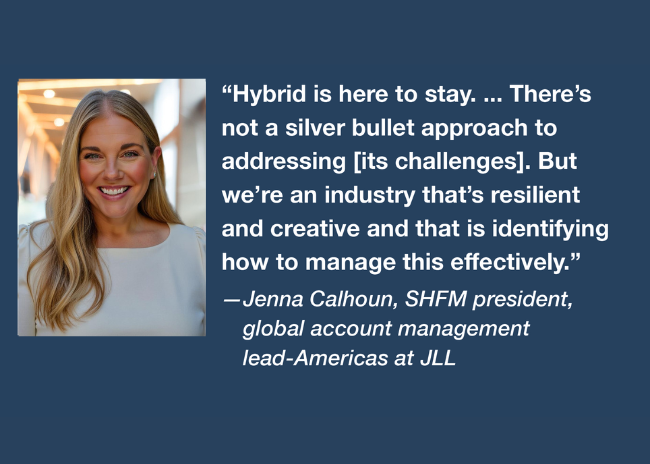
Calhoun feels “Hybrid is here to stay. I think it’s being accepted more widely as the norm.” Foodservice operators and their clients accepting this reality will focus on finding the balance between experience, efficiency, cost and waste within the constraints of hybrid work schedules that impact on-site participation. “There’s not a silver bullet approach to addressing this. But we’re an industry that’s resilient and creative and that is identifying how to manage this effectively,” she says.
Tim O’Mara, vice president, Cini-Little, finds that most of his workplace dining clients have resigned themselves to required core workdays, typically in the middle of the week. “That’s as far as they’ve been able to push. They would much prefer everyone doing a five-day work week, but the ones that are requiring that are seeing employees quit,” he reports.
In O’Mara’s observation, some businesses have been successful in using food and beverage programs as a tool to entice employees to come in for those core days, even among smaller firms that can’t support a full-fledged foodservice operation with an on-site kitchen. O’Mara cites a law firm that offers staff a free breakfast a couple of days a week and a free high-end lunch on Wednesdays.
Given the variety of workplace dining models — from meals prepped and served on-site, cafeteria-style to catered meals brought in from the outside to upscale vending machines and more variations — it’s impossible to summarize the financial impact of hybrid schedules on employer-provided foodservice. According to O’Mara, some businesses that formerly looked at foodservice as its own profit-and-loss operation are now considering subsidizing some or all of the program as a workplace amenity.
Calhoun also points to the opportunities of meeting employees when as well as where they’re at. “The idea of when I work is becoming almost as valuable as where I’m working. That’s a great shift and potentially something that could provide another opportunity — or challenge — for operators and clients.”
2. A Youthquake At Work
The needs and wants of Generation Z continue to play a growing role in shaping the design and programming of today’s workplace dining operations. A strong belief exists that the social aspect of an office environment carries considerable appeal for younger employees. “Foodservice amenities — especially when subsidized — are going to be very attractive,” says James Davella, president and founder, Davella.
Big industries — tech, pharma, financial services and media — set the tone, forcing many other businesses to follow when it comes to recruiting the top talent they all want. “What Google and Apple and the rest did to their on-site foodservice really affected other businesses that need to compete,” Davella says.
O’Mara sees a high-quality, elevated menu as a significant draw, appealing to an audience who isn’t eating at this level at home. “You’re tapping into an unmet demand that most Gen Zs didn’t even know existed,” he says. “As part of the enticement, you step it up a few degrees, offering them things they didn’t know they’d like until they tried it, and then they’re hooked — and will come into the office.”
Davella and his team have seen success in tapping into the coffee culture that is a hallmark of Millennials and Generation Z alike. “We love to offer coffee and coffee bars through multiple dayparts,” he says, noting the positive impact of social experiences on these generations. “For them, standing in line is not a bad thing — you’re looking at your phone, talking to your mates — in that experience, it’s fun. I’ve never seen a user group enjoy standing in a queue as much as Gen Z does, because they’re always plugged in and connected to the outside. And they can multitask like no one else can. We want to create concepts where they can do that.”
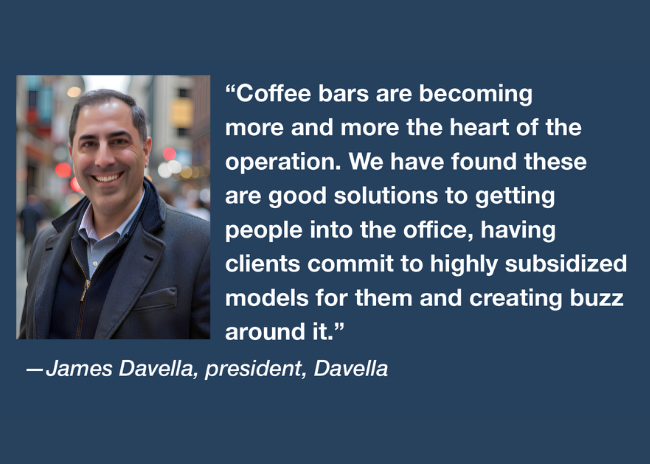
According to Davella, “These coffee bars are becoming more and more the heart of the operation. We have found these are good solutions to getting people into the office, having clients commit to highly subsidized models for that and creating buzz around it.”
Davella finds ways to incorporate highly authentic points of service, even in existing office floor plans. In fact, one advertising company wanted a coffee concept located right in reception. “They wanted clients to come into their space and see their people engaging and interacting, even if they were just getting coffee.”
As digital natives whose entrance to the working world was profoundly impacted by the pandemic, many young professionals no longer have the shared experience of “watercooler conversations” with colleagues at the office. Calhoun laments this loss on their behalf, noting that such exchanges often lead to meaningful relationships that can be valuable to one’s career. “That’s the responsibility of all of us in the hospitality business, to remember why that connection matters so much and extend hospitality across service lines,” she says.
3. Dynamic Space Allocation
New approaches are popping up that maximize any available space for food and beverage programming. Examples include transforming a small, formerly “dead” space in the office floor plan — such as under a stairwell or behind an electrical column — into a micromarket or adding a healthy vending machine in a tight spot, Calhoun says. The idea today, she adds, is about recognizing traffic patterns in an office space, and matching the amenity to the opportunity.
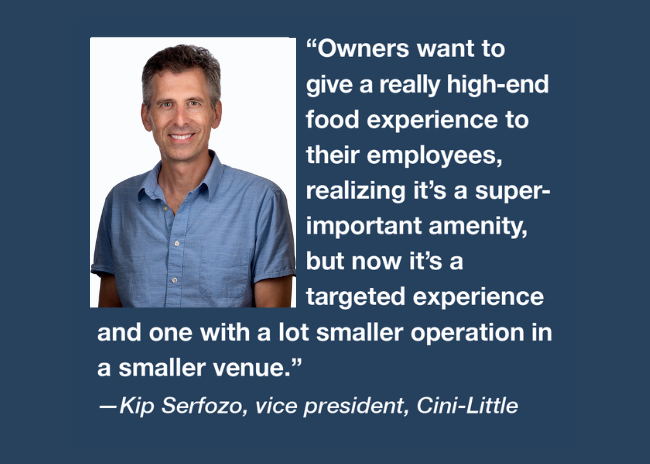
For example, Kip Serfozo, vice president, Cini-Little, was working to “shoehorn in a kitchen” for a client who decided they wanted to cook on-site after they’d finished designing the building. “One of the biggest prevailing trends I see is that owners want to give a really high-end food experience to their employees, realizing it’s a super-important amenity, but now it’s a targeted experience and one with a lot smaller operation in a smaller venue,” Serfozo says.
Serfozo notes that the days of the mega cafeterias seem consigned to the past. “Now, it’s ‘Let’s up our game; let’s make this a cool hospitality experience.’ It’s still full-service, and it’s scratch-cooked, but it’s smaller,” he says.
This is where thoughtful equipment decisions that emphasize high-volume prep in small spaces become critical, O’Mara adds.
Another common goal is to create a dining solution to flex to meet a variety of factors. These range from the impact of low in-office days on participation in the food program to the ubiquitous struggle to recruit and retain qualified foodservice staff. “Whether it’s a multistation servery or a stand-alone cafe, it means opening a select number of stations, rather than all. You’re dealing with the same footprint, but you’re scaling it for the day of the week,” says Calhoun.
Also part of that flexible spectrum is the rise in high-end break rooms and well-stocked catering pantries located throughout the office, says Serfozo. “This allows them to bring food closer to all employees where they are.”
4. Make It a Destination
Attention to the menu in a way that reflects an elevated, culinary ethos is also gaining ground in workplace settings. In fact, it’s representative of Davella’s preferred description of corporate dining as “professional dining,” where the food venue verbiage includes “cafes” and “staff restaurants” rather than “cafeterias.”
Davella understands the value of creating office dining environments that transcend the old corporate cafeteria and become destination experiences. As remote work has proven, today’s office personnel clock in wherever they want, laptops, headphones and smartphones in tow. “People want to get up and go. The office or cubicle is not important. Sit where you want. Take an impromptu meeting where you want. Find your space where you’ll do your best work,” he says. The goal for foodservice, then, is becoming that place where employees want to go.
Often the dining component extends beyond those that work in the office building. Davella recounts a project for a New Jersey pharmaceutical company where the entire hospitality program is open to the public. Located on the ground floor, the series of restaurants — presented food hall-style — are public-facing and open to all. “It just so happens that the pharmaceutical company occupies all the floors above,” he says.
This client liked the way it resonated because the site is “extremely retail oriented,” notes Davella. Foodservice offerings are partially subsidized for the pharmaceutical company’s employees and guests, but the public “can pay full price to get an amazing experience.” Several of the concepts transition to table service with a more elevated menu at night, which changes the paradigm. It represents a new approach for Davella in its corporate work, “And we’re having more of these conversations,” he says. “I’d love to replicate it.”
5. The Tech Effect
Smart equipment will likely play a greater role in workplace dining as cooking technology continues to improve and eases work processes. “There’s a group of oven manufacturers that have really sped away from the competition due to the technology built into the equipment,” says Serfozo. “It’s like having a robot in the oven. It’s so precise and easy to use from a labor standpoint and produces higher-quality food.”
All-electric equipment kitchens also continue to trend, points out O’Mara, adding, “We’re seeing more requests for all-electric equipment, which is fine, if it’s in a location where the power grid can support it.”
Serfozo agrees, noting, “And induction is starting to seep into the mainstream as a major player.”
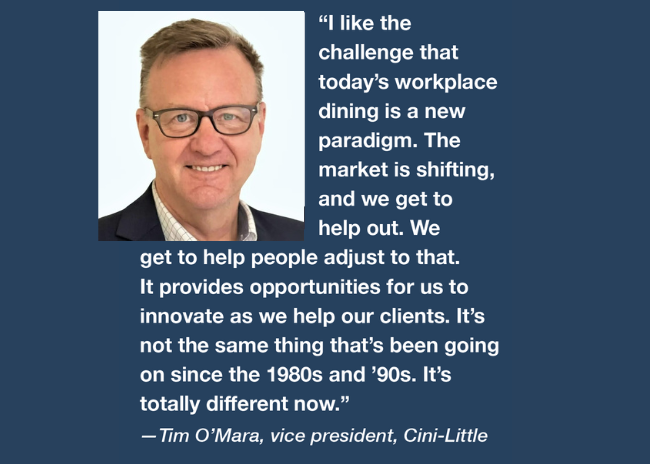
While the winds of change propel all segments of foodservice, workplace dining is clearly taking the first steps along a truly revolutionary road. “I like the challenge that today’s workplace dining is a new paradigm. The market is shifting, and we get to help out,” O’Mara says. “We get to help people adjust to that. It provides opportunities for us to innovate as we help our clients. It’s not the same thing that’s been going on since the 1980s and ’90s. It’s totally different now.”
The Elements of Experience
The corporate dining segment continues to redefine traditional foodservice programming. Cini-Little’s Tim O’Mara and Kip Serfozo share the latest marching orders they receive from workplace dining clients.
Aesthetics: Natural light through lots of large windows, with or without glazes, even outdoor seating options. Varied configurations of indoor seating, with areas for quiet, balanced by areas to congregate around the broadcast of a sporting event. “A variety of dining environments seems to be a big trend,” says Serfozo.
Menu Variety and Quality: Multiple concepts offered daily that reflect consumer interest in trend-forward flavors, comfort-food favorites, nutrition, wellness and lifestyle, as well as allergen-free options. Chef-crafted, scratch-prepped options featuring local, seasonal ingredients. “High-end foodservice is morphing into the workplace,” Serfozo observes.
Multiple Points of Service: A primary servery with multiple stations that might be supported by, for example, a high-end barista service in the hallway and/or a small, higher-end grab-and-go station in another part of the building or campus that features made-to-order prep. “On one project, they told us that some employees only have
20 minutes to eat, but the client wanted to ensure they’d have the same level of quality as if they had gone to the main servery,” says O’Mara.
Digital Ordering, Made-To-Order Prep: Meals that can be ordered online from the employee’s workstation but made fresh to customer specifications and available for speedy pickup.
Employee Subsidy: Creating high-end food and beverage experiences doesn’t come cheap. Budgeting has taken on a new level of scrutiny for contract management companies when it comes to contracts, says O’Mara. Overall, “We always ask what clients want the food and beverage program to provide operationally, culturally and financially,” he says. “That’s the driver for what we program and what ends up being designed. But sometimes, “clients don’t know what they don’t know. They’ll see another cool cafeteria and say, ‘I want that!’ We have to bring the client back to thinking of their own programming goals and develop a program that meets their individualized needs.”