Salad concepts face a number of challenges unique to their segment.
 Their niche customer base limits their audience, and their reliance on fresh, often labor-intensive ingredients adds pressure to both food and operating costs. In today’s economy, that’s a tough mix — especially when a $20 salad can make even the most health-conscious diner hesitate. Still, leading salad chains continue to find ways to thrive, tapping into consumer demand for fresh, “clean,” and veggie-forward meals while navigating pricing pressures and shifting expectations.
Datassential reports that Sweetgreen, Freshii and Saladworks remain the top-ranked limited-service salad chains as of mid-2025. Other fast-growing players include Just Salad, which saw nearly 88% sales growth in 2024, and Crisp & Green, up 44% during the same period, according to earnings reports. Chopt ranked among the top 250 chains nationwide, reporting $160 million in sales and 14.6% growth. Other emerging brands continuing to sprout with potential by capturing consumers’ growing appetite for healthier, customizable fare include Pure Green, which, according to Datassential, posted 59% unit growth last year; Honeygrow (36%); and Playa Bowls (34%).
But that growth hasn’t come easily. “When you look at the big guys like Sweetgreen, it’s a hard road for them because it’s getting people to pay $20 or $25 for a salad,” says Jay Bandy, president of Goliath Consulting Group. “That’s where there’s a disconnect with a larger market. How many general consumers understand that it’s going to cost you 50% more for something that’s actually healthy and has the proteins and ingredients you want?”
Sweetgreen has felt that burn for sure. After moving closer to profitability in early 2025, the chain’s second quarter 2025 net loss widened to about $23.2 million, reflecting softer traffic and a 7.6% same-store sales decline. Still, the brand continues to innovate, testing a fully automated makeline at its Naperville, Ill., location. Using robotic arms to assemble salads and bowls, the system can reportedly produce up to 500 orders per hour with near-perfect accuracy. The company also plans to expand the automated format to 25 more locations this year.
Salad-focused brands have learned that success requires finding the right customer — and the right market. “It’s easy in casual dining because I can afford a salad that’s a 35% food cost because I’m selling something else at 25%,” says Bandy. “But when salads are your only item, that’s a challenge.”
Geography and income matter, he adds. “If you’re in Beverly Hills or somewhere on the West Coast, high-income, and you can charge $25 for a salad and get your food cost under 30%, you’re going to make money. The real battle is competing in the general consumer market. If I’m in Buckhead in Atlanta, or areas where incomes are $100,000 and up, it’s not an issue. But going into markets where incomes are $70,000 per person — that’s where the battle is.”
Chop Stop, a Southern California-based franchise with a menu centered on chopped salads, knows this competition all too well. “My competition has become anybody that sells salad,” says Joey Gonzalez, owner and operator. “There’s so much competition now that everything is just spread really thin.” Before COVID-19, Chop Stop customers visited an average of 2.7 times a week; now that number is closer to 1.3 times, Gonzalez says.
Scratch-Made Quality
If there’s one thing all successful salad chains have in common, it’s their commitment to freshness. Salata, based in Houston, operates 99 locations, about 95% of which are franchised. “We’re getting ready to celebrate our 20th anniversary,” says Sammy Seymour, vice president of operations. “The concept started in downtown Houston, and growth has come in spurts over the past two decades. In the last five years alone, we’ve added about 15 to 20 new locations.”
At Salata, every salad and wrap are built to order from six bases, more than 50 toppings, and 11 housemade dressings. “We prepare everything fresh each morning — cutting produce, cooking proteins and baking items like cookies and croutons,” Seymour says. “Prep is typically completed by the start of lunch, and that same team moves to the front line for service.” All of Salata’s food, except soups, is served cold and produced under strict two-day shelf-life standards. Dressings, sauces, and soup bases are made in a central commissary to ensure consistency across markets.
The same philosophy drives Tender Greens, based in Los Angeles with about two dozen locations in California. “We are mostly a scratch kitchen — I would estimate at about 90% to 95%,” says Craig Carlyle, chief operating officer. “Dressings are one of the items we partner with a company to make for us using our recipes and ingredients to ensure consistency.”
Tender Greens’ seasonal menu emphasizes locally sourced produce and sustainable proteins, while evolving to include new, globally inspired items like the limited-time Mediterranean Steak Bowl — a colorful mix of grilled steak, vegetables and zhoug sauce served with naan. “Local and sustainable have been part of the concept since inception,” Carlyle adds. “The relationships with our vendor partners, including many local farmers, are very important to us.”
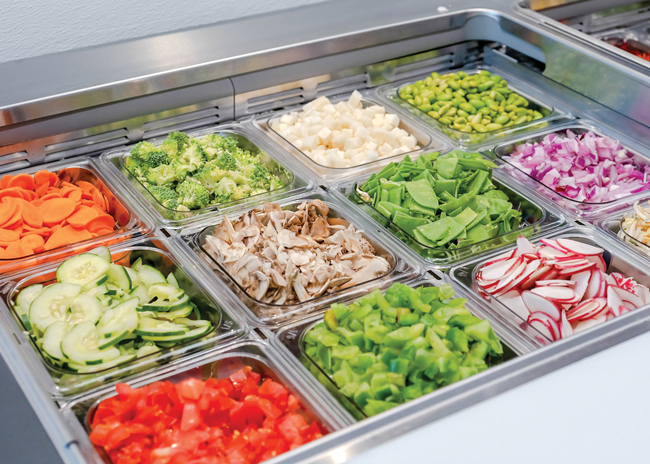 Houston-based Salata operates 99 locations, about 95% of which are franchised, and features a diverse selection of more than 50 fresh toppings for its salads and wraps.
Evolving Menus
To offset rising food and labor costs, other than turning to technology like Sweetgreen has, operators are experimenting with more menu innovations that include comfort-driven or warm offerings that extend appeal beyond salads alone.
“I’ve introduced garlic steak, poke and burnt ends,” says Gonzalez of Chop Stop. “We added warm rice and bean bowls, and we created what we call a ‘chapanini,’ a warm salad in a tortilla.”
Similarly, Bandy notes that operators are “figuring out how to meet consumer need but also find profitable items that help them balance their menus.” His Atlanta-based client, CraveWell Cafe, recently introduced quesadillas alongside salads and juices, leveraging existing ingredients and equipment. “You already have veggies for juicing — put them in a tortilla with some cheese, and you’ve got another healthyish item to sell,” he says.
Limited-time offerings have also become a key tactic to keep menus fresh and test new items. Saladworks recently introduced its Chicken Pickle Crunch Salad and other Pickle Ranch items, while Tender Greens and others rotate seasonal bowls and salads multiple times a year.
Driving Convenience
Drive-thru and digital convenience continue to reshape the category. Just Salad opened its first drive-thru this year and plans more in 2025. Salad and Go, which has built its brand around the model, now operates more than 140 drive-thru units across multiple states.
For Salata, convenience means balancing dine-in and digital sales. “We typically see a 50/50 split between dine-in and takeout, with 20% to 25% of business coming from online ordering and catering,” Seymour says. “Our online ordering is fully customizable — guests can order through our app or salata.com, and we integrate with third-party delivery partners.”
At Chop Stop, drive-thrus are also gaining traction. “Eighty percent of our business is out the door,” Gonzalez says. “We use all of them — DoorDash, all the catering companies, anybody that can drive sales to our restaurants.” The company’s Reno location even features a double drive-thru, which Gonzalez says has earned “the highest ratings in Reno for service.”
Design and Equipment
From a design standpoint, salad concepts require thoughtful space planning and prep systems to support their scratch-made, high-turnover menus. At Salata, the ideal unit footprint measures 2,500 to 2,800 square feet, with smaller food-court setups coming in at less than 1,000 square feet and larger suburban sites topping 3,500 square feet.
“Despite the variations, every location includes the same cold prep area, hot prep, dish and storage spaces — all centered on a small kitchen footprint that’s highly efficient,” says Seymour.
At Chop Stop, simplicity and efficiency are the name of the game. “We don’t cook in our restaurants,” Gonzalez says. “We have no stoves or ovens — just panini grills and rice cookers. Eighty percent of our sales is cold salads.” Each restaurant includes a compact prep area to handle the high volume of fresh chopping using food processors for speed chopping.
“In smaller stores, everything’s on wheels so we can move carts around as needed,” Gonzalez adds. “Our dining room might have four tables, but the line and prep space are designed for speed.”
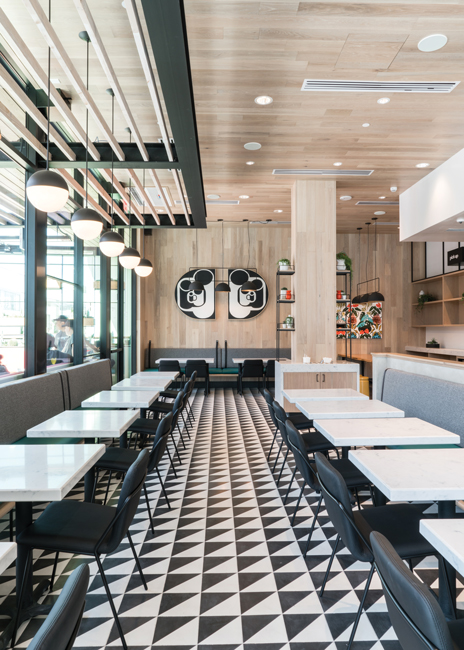
Tender Greens follows a similar approach, operating like a full-service kitchen with walk-ins, multiple prep stations and separate lines for online and in-store orders. “It’s a mixture of art and science to get it exactly right,” says Carlyle. “Accurate inventories, accurate prep lists — we count on our leaders to work that balance every day.”
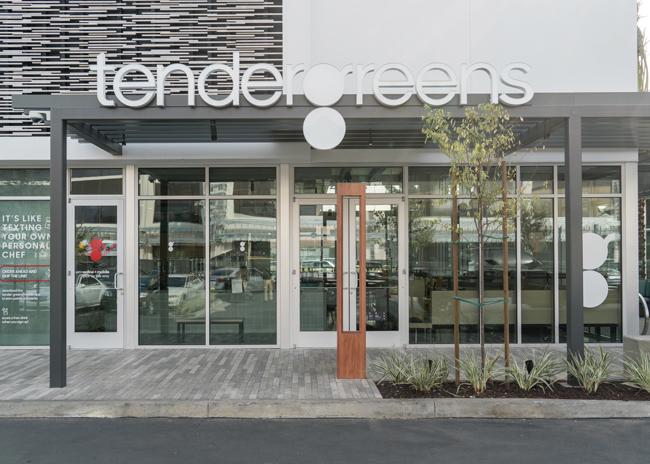 Here and opposite: Los Angeles-based chain Tender Greens features a mostly scratch-based menu with house-made dressings produced at a central commissary.
Looking Ahead
Despite the operational and economic challenges, the salad segment continues to evolve and grow. From automation to limited-time offerings to sustainability storytelling, brands are finding creative ways to stay competitive in a crowded, cost-sensitive market.
“The innovation happening right now — that’s what’s going to sustain these concepts,” says Bandy. “If you can deliver quality, freshness and convenience at the right price point, there’s still plenty of opportunity to grow.”
Sustainability and the Next Generation
According to Tastewise’s 2025 Gen Z Food Code report, 36% of Gen Z shoppers opt for “natural” items, compared to 20% who prioritize “organic.” They also value local produce, low waste and functional ingredients such as matcha, miso and sea moss. Nearly 73% say they’re willing to pay more for sustainable products, and 85% say sustainability impacts their purchasing decisions.
For Tender Greens and similar brands, these values are core to their mission. “We like all the criteria necessary to qualify for organic, but we understand the certification can be cost-prohibitive,” Carlyle says. “That’s motivated us to partner with suppliers who meet the same standards, even without the certification.”