New approaches to dining include adapting foodservice to different levels of care and a greater variety of formats.
High-end dining venues and engaged seniors sharing meals reflect a different approach to senior living compared to decades ago. Indeed, expectations have changed.
The most dramatic changes in senior dining have been at independent living and continuing care campuses, says Harris Ader, founder and CEO of the Senior Dining Association. “There’s more of a hospitality point of view, with multiple dining venues and stations,” he says. “Three-meals-a-day dining plans have been replaced by flex plans that use dining dollars or points to allow residents to pick and choose what they want to eat and when. You can have whatever you want, including liquor.”
“Baby Boomers are redefining what senior living dining looks like,” notes Dr. Milton McGowian, chief operating officer at The Sharon at SouthPark in Charlotte, N.C. “Boomers expect choice, flexibility and experiences similar to restaurants, resorts and cruise ships. They’re food-savvy, wellness-driven and accustomed to customization.
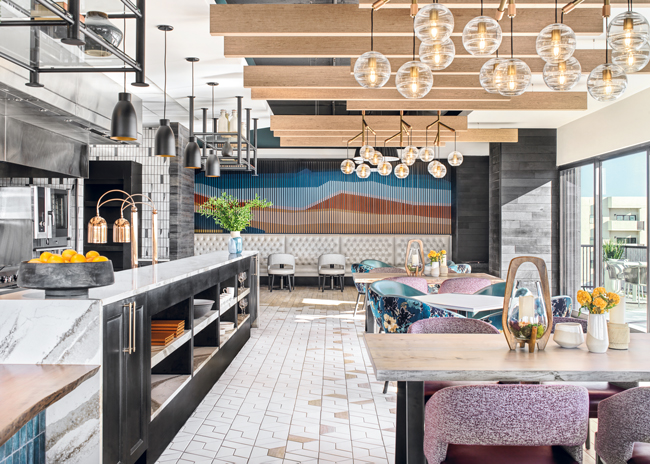 A major remodel for Friendship Village in Tempe, Ariz., included a full-service restaurant with an open grill line, a semi-formal dining room with a focus on seasonal and local ingredients, and facilities for cooking classes and wine tastings. The bar opens up to the roof and features a tapas menu. Photo courtesy of SCOPOS Hospitality Group; photo by Alise O’Brien
“Ten years ago, salad bars and one chef’s special were common; today’s seniors want plant-forward options, global flavors and the ability to dine on their own schedule,” McGowian adds. “The demand for fresh, seasonal and local ingredients has accelerated. Menus are designed with wellness in mind, with lower sodium, heart-healthy oils, lean proteins and customizable portioning.”
For residents in assisted living and skilled nursing care, hospitality services may be limited and strict regulatory oversight and insurance reimbursements make for extra paperwork. In these environments, menu options may not be as broad as in independent living communities, Ader says. These facilities offer three meals a day, often with additional nutrient supplements.
Modifying diets for assisted care residents is “more logistics than anything else,” Ader says. “The same menus can be used at all care levels.” Dietitians now use software to select options for diabetics and other residents on restricted diets. Foods may be pureed and shaped for people who have problems chewing or swallowing. Technicians help assisted living residents place their meal orders on a Wi-Fi-enabled tablet.
Most senior living communities still include a dining room with waiter service; residents may use a computer or mobile app to reserve a seating time and preorder their meals. There may also be a counter-service spot offering dine-in and takeout, a bakery cafe or coffee-and-juice bar, and perhaps a pub. Most communities also offer residents and their guests catered meals in private dining rooms and takeaway meals that can be ordered via a mobile app or kiosk to eat in apartments or elsewhere. Senior living communities may also offer delivery (for a surcharge).
Food preparation that’s visible to residents is trending, Ader says: “You’re seeing hibachi stations with residents sitting around a griddle watching food being cooked. Hearth ovens for pizza, rotisseries for chicken, food served from mobile carts. Coffee and cappuccino machines, wine dispensers and wine walls.”
Dining venues may be clustered around a central kitchen or scattered across campus with their own limited kitchen and servery backed up by the production kitchen.
Making It Work: Equipment and Tech
It may take high-end equipment to do high-quality, from-scratch cooking for large senior living campuses, says Shawn Kaley, vice president of consulting services at The Hollyday Group, which offers management advisory services for senior living and assisted living communities. He notes that “combi ovens nowadays are considered a cost of doing business.”
Another common piece of equipment in senior dining spaces is large kettles for high-production cooking or advanced cook-chill systems with tumble chillers — which preserve the quality of food and make it last longer. When considering that purchase, Kaley recommends determining “how many meals you’ll be serving for how many residents, the cost savings of making your own soups and sauces and so on, to decide how long it will take to recoup your investment.”
To create efficiencies in the senior living space, technology is at least as important as kitchen equipment, Kaley says. “Back-of-house operating programs, linked to a current point-of-sale system, is the way you achieve consistency in procedures and recipes, avoid preparing too much food that will become waste and become successful in the long term,” he says.
Overseeing the Dining Department
Ader estimates that 80% to 85% of dining services departments in senior living are self-operated, with the rest contracted. “If you know what you’re doing, you can run a great foodservice program on your own,” he says, “but contract companies come to the table with a specific knowledge base and resources, and that team support can help.”
Kaley’s company helps clients evaluate the pros and cons of switching from self-operated to contract foodservice or vice versa, and sometimes works as a liaison between senior communities and foodservice contractors. “There will always be a percentage of contract operators, but I think the majority of senior living communities will retain the self-op model,” he says.
And he notes that, increasingly, senior living communities are aggregating into large regional systems with economies of scale that may duplicate the advantages offered by contract management companies. “Good operators in communities like that are taking advantage of the buying power of a larger system, whether they’re working with a broadline distributor or a group purchasing organization,” he points out.
 Some senior communities in the Arbor Company network are growing their own microgreens; others are harvesting produce from on-site vegetable gardens where residents participate in the gardening tasks. Photo courtesy of The Arbor Company
Up Close at The Arbor Co.: A Self-Op
As a regional vice president of dining services at The Arbor Company, chef Marcus Malone oversees 16 of the system’s 50 senior living campuses. He believes the size of his system means that its self-operated dining departments enjoy advantages similar to those offered by contractors — plus collegial work environments, receptivity to local needs and the ability to make changes quickly.
“All of our dining teams are connected,” Malone explains. “We have a lot of group meetings and spend time bouncing around ideas. There are corporate menus that a dietitian has signed off on; we send them to the dining directors as a template, but they can customize menus for their residents’ regional preferences. All of the communities have access to an online recipe database, where they can showcase what their community is doing and add photos.”
Employee involvement is vertical as well as horizontal, Malone says. “If we have an issue, I can always call our vice president of culinary, or get in touch directly with the president of the company,” he says. “We may talk about what the trends are in different markets, what things are working and what aren’t.” He also adds that being self-operated means being able to shift direction more quickly.
The Arbor Company takes the same approach to the design of its dining spaces that it does to staffing: a uniform template, adaptable to local needs. “All of our communities have a tablecloth-service restaurant that offers at least one meal a day,” Malone explains. “We try to emulate five-star restaurant dining to the extent we can within each facility’s budget. Then, we always have a bistro-type venue with coffee, pastries, sandwiches and grab-and-go snacks. There’s usually a chef demo kitchen as well.”
Working to a five-star restaurant standard means “we try to get the best restaurant equipment we can,” Malone says. “Most of our food is made in-house from scratch, so all of our cooklines include convection ovens, flattop grills, deep fryers and kettles. We have combis, both small and regular size. We do small-batch cooking as much as possible, but we can hold some food that we have been braising. We have a steam table line in most of our communities. And we do sous vide in certain markets, allowing us to grill meat beforehand and then finish it off just before service.”
There are changes afoot in the Arbor Company network. Malone has been talking to robotics companies about adding nonhuman servers and bussers. Going forward, he says, newly built communities will have POS-linked smart kitchens with overhead screen displays at each workstation. And there’s a pilot program in which dining departments are growing their own microgreens rather than sourcing them from a produce supplier, while other communities have established full-blown vegetable gardens where residents are invited to help the staff grow and harvest foods to be showcased on their menus.
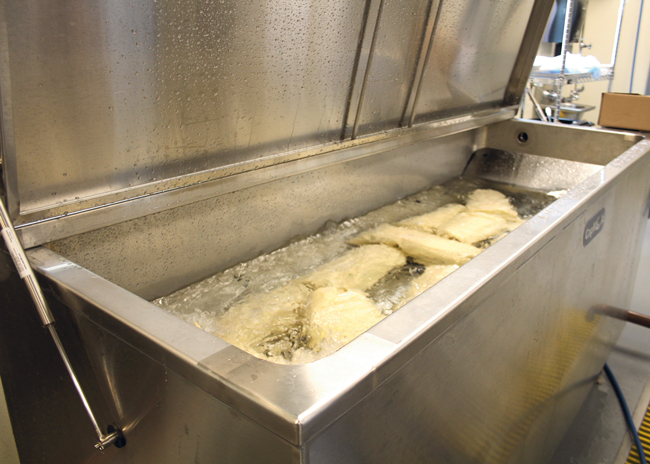 Sous vide systems are widely used in senior living communities to produce meal items that are batch-cooked in bulk in advance, then finished and heated just before service. This equipment at Cura Hospitality’s Menno Haven Retirement Communities can cook 400 pounds in one cycle.
Up Close at Menno Haven: Central Production Kitchen
The two Menno Haven retirement communities, a mile apart in south central Pennsylvania, executed a major foodservice upgrade a few years ago. “We built a central kitchen that produces 75% of all the food served, reducing food costs by 10% because we cut down on inventory and waste,” says Jeremy Fry, Cura Hospitality’s resident district manager. “We also reduced staffing. Instead of five bakers across our campuses, we have two.”
One ongoing challenge: hot food degrades in quality between production and service. Solution: “If there’s anywhere in the recipe to pause, we do that. One chef makes lasagna for the entire community, but we don’t finish baking; the pans are wrapped, put on refrigerated trucks and finish baking on-site.” Soups are fully cooked in the commissary kitchen, bagged and distributed, and then warmed in each location in retherm vessels with timers.
A large production kitchen requires heavy equipment. “We have a sous vide machine that can bag 400 pounds at a time,” Fry says. Two blast chillers cool food quickly, retaining quality.
For independent living residents, Menno Haven offers the usual options — a waiter-service dining room, a casual cafe, 24-hour grab-and-go markets — but between the formal and informal dining rooms, there’s also a grill with an open kitchen. Menus emphasize local products, including grass-fed beef from an area farm used for a signature burger. The other signature item: pizza from freshly made dough, baked in a display pizza oven.
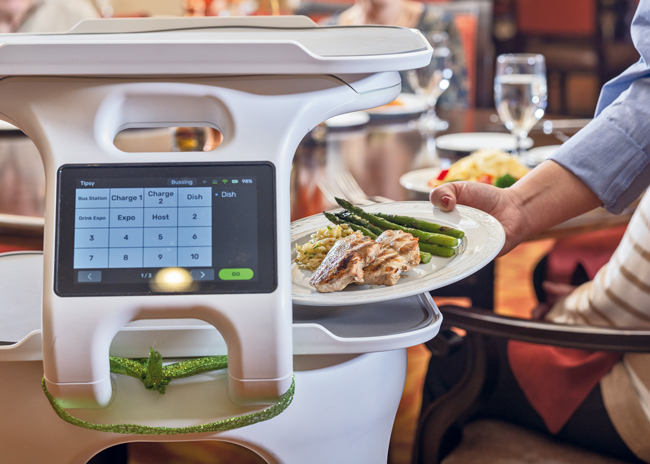 In the dining room at Providence Point, a robot is used to bring food to tableside for servers to distribute to individual diners. Another robot is used to bus dirty plates to the dish room. Photos courtesy of Cura Hospitality
Up Close at Providence Point: Robots and Waste Control
Providence Point, a Baptist senior community in Pittsburgh, relies on both a main kitchen and satellite kitchens, says Cheryl Torre-Rastetter, Cura Hospitality’s director of dining services there. Equipment in the production kitchen includes two stacked combi ovens used for steaming, baking and browning, as well as a high-end cooking suite with a deep fryer, pasta cookers and broilers. Programmable, ventless rapid-cook ovens are installed “in every area of every kitchen,” she says. “They’re nice for short-order cooking done well, coming out the same way every time.” Additionally, the cafe features a customized range suite with cook-to-order induction on one side and a burger grill on the other.
Helping the humans on the dining staff are two robots. After a staff person at the expo station checks each meal ticket against the tray of food, one of the robots takes the meals to tables for staff to serve; the other busses dirty plates back to the dish room. The robot system has reduced breakage, and servers who don’t have to lift heavy trays can fill in as hosts and spend more time interacting with residents, Torre-Rastetter says.
She also praises Cura’s “Waste Nothing” waste-control system based on waste tracking, portion control and creative reuse of excess production. “We cut our own filets, cut our own salmon. It’s labor-intensive, but it gives us portion control,” she says. “We do more cook-to-order food instead of batch cooking. And anything we cook that doesn’t get used will be flipped to another use.”
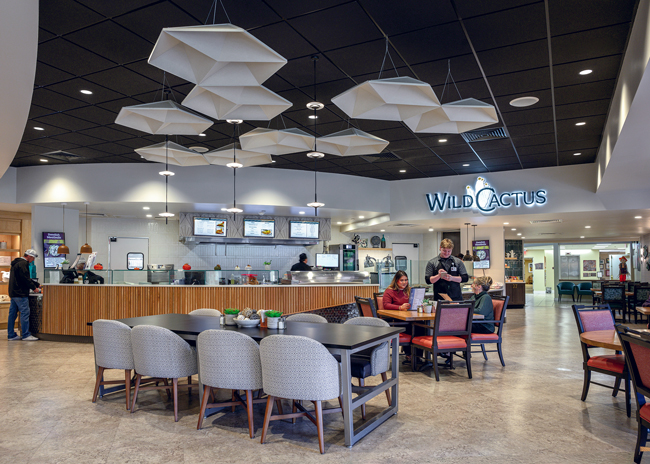 At Royal Oaks Retirement Community in Sun City, Ariz., Scopos Hospitality Group transformed six venues into efficient branded spaces embracing a desert aesthetic: Thrive Coffee Shop, Oasis Market, Wild Cactus Bistro & Grill, Sonrei Expo Restaurant, Willow Reserve Wine Room and 1983 Pub. Features like a robotic busing system, self-checkout market and cooking demonstrations elevate service and engagement. Photo courtesy of SCOPOS Hospitality Group; photo by Michael Duerinckx
Curated Community
“Every community offers its own culture and approach,” says Joe Gorman CEO of Aramark SeniorLIFE+, which serves more than 300 senior communities. “We provide curated solutions tailored to each community’s dining venues. That includes designing the space, crafting menus, setting operation hours and sourcing sustainable foods made with fresh ingredients from local farms and suppliers.”
SeniorLIFE+ picks up ideas from both on-site foodservice and restaurants, Gorman says. “We may turn to the restaurant affiliations we have to figure out how to put new, creative dining ideas into the senior environment, like the recent Korean Bowl pop-ups at five of our Asbury Communities accounts.”
Efficiency is the name of the game in senior dining. “Our foodservice designers work with the client to create the smallest-square-footage kitchen that will serve their needs, with the fewest steps to save on labor, and equipment like multimode speed ovens and sous vide systems to produce food quickly and hold it efficiently,” Gorman says.
Cura Hospitality, a division of Elior North America, offers dining services for life plan communities and acute care nursing centers.
Senior living centers and acute nursing care are multigenerational, multicultural environments, says Cura president Trish Spellman. “It’s a significant challenge to address cultural differences in the work environment to ensure that we have completely satisfied resident and worker needs. The dining staff engaging seniors are primarily younger — students and teenagers. Seniors love to see them.”
Some Cura locations have 24-hour self-service options for residents and staff. Some feature unstaffed self-service c-stores or gift shops. Just Baked — self-contained kiosks — purvey hot dumplings, soups, pizza and other foods, made fresh as purchasers wait.
While service styles and menus will undoubtedly continue to evolve in the coming years, one key ingredient in senior living dining will remain the same: the need to provide nutritious and comforting foods in environments that make residents and their families feel at home.
 Healthy bowls—salads as well as dishes featuring proteins and grains like quinoa—are a key trend in senior dining. Photo courtesy of Aramark SeniorLIFE+
Aging Population Update
The number of people in this country who are 65 years or older rose almost 39% in just the last decade and is projected to increase another 42% by 2050, according to the U.S. Census Bureau.
As the Baby Boomers begin to move into their golden years, senior communities of all types will welcome a bumper crop of new residents.
Senior living arrangements can take on various forms to meet different care needs. Here’s how the Federal Long Term Care Insurance Program defines them:
Independent living communities: For active adults (typically 60-plus) who can care for themselves. Amenities may include swimming pools, outdoor walking paths, gathering spaces, fitness centers and multiple restaurants.
Assisted living communities: For older adults who might benefit from extra verbal or hands-on support with activities of daily living. Typical amenities are gardens, fitness programs and group activities.
Memory care communities: For adults living with dementia. Staff have special training in dementia care best practices.
Nursing homes/skilled nursing communities: Licensed facilities with 24-hour nursing care, medical care, maintenance and personal care, therapy and other health-related services.
Continuing care retirement communities (CCRCs): Every type of senior living solution on one campus—independent living, assisted living, memory care and nursing care.